


Space Exploration
- Home
- Space Exploration

- Scientists have discovered a crater on the moon that's bigger than the Roman Colosseum and is the result of a powerful impact two years ago that initially went undetected.
- SpaceX announced Tuesday that it was planning to send its flagship rocket, Starship, into orbit, a key step in its project to one day reach the moon or Mars.
- Scientists from Trinity College Dublin have developed a way to unravel changing weather patterns on distant worlds. Using this approach, they discovered that the weather on a well-studied brown dwarf, SIMP 0136, previously linked to northern lights-like phenomena, is largely shaped by just two dominant processes: changes in temperature and the vertical structure of its clouds.
- The discovery of water in dark craters at the moon's poles has sparked a "moon rush" to establish bases there, followed by villages, cities and heavy industry. How sustainable is this rush?
- Mars is a terrible place to build a house. It's bitterly cold, blasted by radiation and a near vacuum. Not to mention that the building materials, even for a modest shelter, could spend months hurtling through space before construction begins.
- As NASA prepares to send humans to Mars as early as the 2030s, University of Mississippi researchers are working on one of the key questions: How will they get back?
- There are nearly 1 million pieces of debris larger than 1 centimeter (0.4 inch) in near-Earth orbit. As we continue launching spacecraft and telescopes to explore the universe, this debris poses a significant threat of high-speed impact damage. In the Journal of Applied Physics researchers from Dalian University of Technology in China explored an eggshell-inspired design as a potential spacecraft protection material.
- A private spacecraft that was supposed to provide a lifeline to NASA's Swift Observatory managed to get close to the sinking telescope and even snap photos two weeks after the rescue was abandoned.
- When Blue Origin's New Glenn launch vehicle accidentally exploded during a static test fire in May 2026, the explosion generated low frequency soundwaves below the range of human hearing.
- The moon's getting its first airport, and it's about to get busy. Within the next two decades, NASA's planned Gateway—humanity's first lunar spaceport—may become a bustling hub for Orion crew capsules, lunar landers, cargo vehicles and astronauts traveling between Earth, the moon and, eventually, destinations in the deep unknown.
- Washington State University researchers used artificial intelligence to find a more efficient, less expensive way to 3D-print a high-performance metal alloy, saving researchers from needing to painstakingly test more than 100 million options.
- Now it's the moon's turn to pull a disappearing act. After being shut out of this month's total solar eclipse, the Americas will have the best seats in the celestial house when Earth's shadow briefly envelops the moon. Almost the entire lunar surface will be masked Thursday night into Friday—a whopping 96%—making this an especially deep partial eclipse.
- During a coronal mass ejection (CME), the sun hurls billions of tons of magnetized plasma into space. These eruptions are among the most powerful events in the solar system, and when they are aimed toward Earth, they can seriously threaten the satellites and power grids we depend on. For now, it remains notoriously difficult to predict how these eruptions evolve over time—and, in turn, whether they might be heading toward us.
- The mission to save NASA's sinking Swift Observatory was called off Wednesday, dooming the telescope to a fiery reentry later this year.
- Between Aug. 11–12, NASA's Lunar Reconnaissance Orbiter (LRO) captured a series of images of a new crater on the moon. The crater formed Aug. 5, when a SpaceX Falcon 9 upper stage impacted the surface following its Jan. 2025 launch of the Firefly Blue Ghost 1 mission.
- Using unique equipment installed on NASA's WB-57 aircraft flying above heavy clouds off the coast of Iceland, a Southwest Research Institute-led team successfully observed a total solar eclipse on Wednesday. The high-altitude jet followed the moon's shadow at 50,000 feet (15,000 meters) to take measurements of the solar corona in nine different wavelengths, ranging from visible to infrared light.
- For astronauts in space, constipation is a well-known problem. But why this happens has long been unclear. Now, a new study from the University of Copenhagen in collaboration with NASA provides an idea of what happens in the stomach without the influence of gravity.
- A tiny UK-developed satellite, roughly the size of a small carry-on suitcase, could help answer one of the biggest questions in cosmology: What happened during the roughly 150 million years of the cosmic dark ages, before the universe's first stars appeared?
- It's common to see images of astronauts on the International Space Station exercising, running on special treadmills and pedaling cycles designed for tight quarters.
- To date, close to 30,000 satellites have been launched into Earth's orbit, leading to mounting concerns over the debris created when they collide. In a new analysis posted to the preprint server arXiv, Hugh Lewis of the University of Birmingham shows that satellite constellations can grow so large that they cross a critical size beyond which they generate unstable, runaway amounts of debris. The findings point to an urgent need for tougher rules on which satellites are allowed into orbit in the first place.
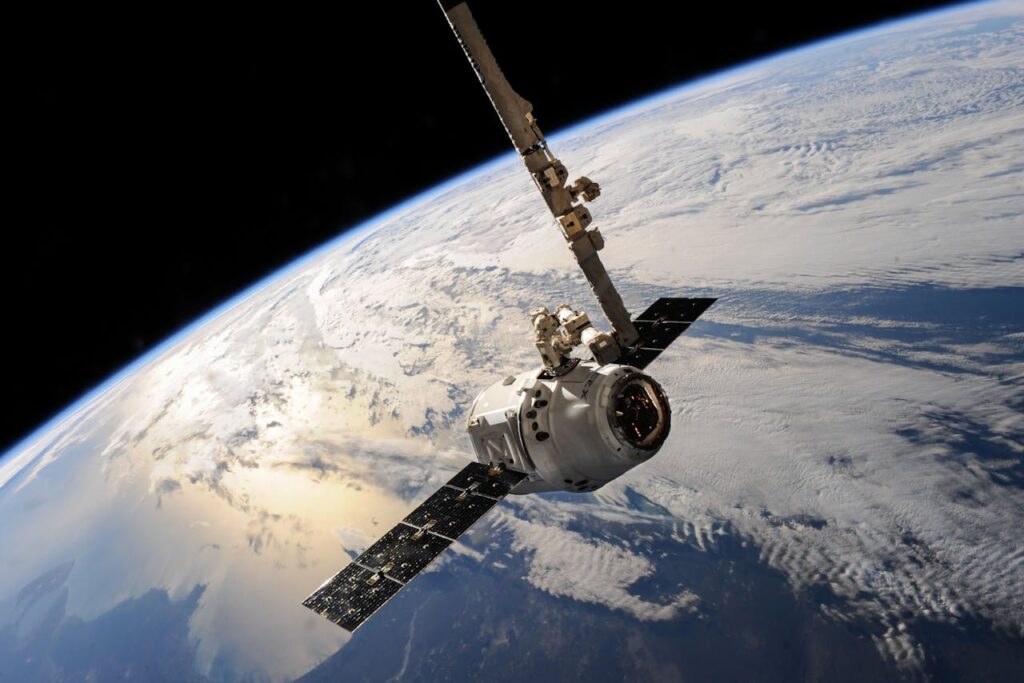
Foto: SpaceX auf Pexels