
Space Exploration
- Home
- Space Exploration

- The moon's surface may be more than just a dusty, barren landscape. Over billions of years, tiny particles from Earth's atmosphere have landed in the lunar soil, creating a possible source of life-sustaining substances for future astronauts. But scientists have only recently begun to understand how these particles make the long journey from Earth to the moon and how long the process has been taking place.
- NASA has lost contact with a spacecraft that has orbited Mars for more than a decade.
- Much remains to be known about the chemical composition of small asteroids. Their potential to harbor valuable metals, materials from the early solar system, and the possibility of obtaining a geochemical record of their parent bodies makes them promising candidates for future use of space resources.
- It's time for one of the strongest meteor showers of the year.
- Stanford researchers have become the first to demonstrate that machine-learning control can safely guide a robot aboard the ISS, laying the groundwork for more autonomous space missions.
- High up in Earth's orbit, millions of human-made objects large and small are flying at speeds of over 15,000 miles per hour. The objects, which range from inactive satellites to fragments of equipment resulting from explosions or collisions of previously launched rockets, are space debris, colloquially referred to as space junk. Sometimes the objects collide with each other, breaking into even smaller pieces.
- Light from the half a million satellites that humanity is planning to launch into Earth's orbit in the coming years could contaminate almost all the images taken by space telescopes, NASA astronomers warned Wednesday.
- New research conducted on a NASA-discovered bacterium shows the microbe is capable of entering an extreme dormant state, essentially "playing dead" to survive in some of the cleanest environments on Earth.
- Analysis of the second confirmed interstellar comet to visit our solar system suggests that the alien body could be covered in erupting icy, volcano-like structures called cryovolcanoes. Researchers also discovered that the comet has a metal-rich interior, which could challenge our understanding of how comets formed in our own planetary system.
- Eating from pouches, sleeping in a bag tied to the wall, using a vacuum-powered toilet: Basic processes of human life require scientifically tested solutions in space. It's the same for menstruation, a process female astronauts must plan for before flying to space, especially for longer missions in the future.
- Since humanity's first steps on the moon, the aspiration to extend human civilization beyond Earth has been a central objective of international space agencies, targeting long-term extraterrestrial habitation. Among the celestial bodies within reach, Mars is considered our next home.
- Ask someone on Earth for the time and they can give you an exact answer, thanks to our planet's intricate timekeeping system, built with atomic clocks, GPS satellites and high-speed telecommunications networks.
- Every time a rocket is launched, tons of valuable materials are lost, and huge amounts of greenhouse gases and ozone-depleting chemicals are released into the atmosphere. Published in Chem Circularity, sustainability and space scientists discuss how the principles of reducing, reusing, and recycling could be applied to satellites and spacecraft—from design and manufacturing to in-orbit repair and end-of-life repurposing.
- The last supermoon of the year will shine soon in December skies.
- Imagine biting into a crisp, garden-fresh salad and savoring juicy strawberries for dessert. But instead of your backyard, you're gazing out at a stark lunar landscape, Earth hanging like a precious blue marble in the inky sky.
- Whether it's a sprained ankle or a backpack at the airport, X-ray images are an everyday occurrence in many areas. Empa researchers at the Center for X-Ray Analytics have succeeded in taking images that are far less commonplace: In collaboration with the Swiss Space Center (now Space Innovation at EPFL) and the Swiss Museum of Transport, they have X-rayed an entire satellite.
- Lunar samples serve as a critical link between orbital remote sensing and ground-truth measurements. Previous sample-return missions—Apollo, Luna, and Chang'e-5—have collectively brought back approximately 383 kilograms of lunar soil and rock from the moon's near side, advancing the understanding of lunar geological evolution and regolith properties. However, the absence of samples from the far side has limited investigations into its unique composition and geologic history.
- As this month's string of powerful X-class solar flares sparked brilliant auroras that lit up skies across an unusually wide swath of the globe—from northern Europe to Florida—researchers at NJIT's Center for Solar-Terrestrial Research (CSTR) captured a less visible, but crucial, record of the storm's impact on Earth's upper atmosphere.
- A flying piece of cosmic rock or an alien threat? Comet 3I/ATLAS is hurtling through our solar system and captivating scientists and internet users alike, even prompting Kim Kardashian to ask NASA for answers.
- Mosses thrive in the most extreme environments on Earth, from the peaks of the Himalayas to the sands of Death Valley, the Antarctic tundra to the lava fields of active volcanoes. Inspired by moss's resilience, researchers sent moss sporophytes—reproductive structures that encase spores—to the most extreme environment yet: space.
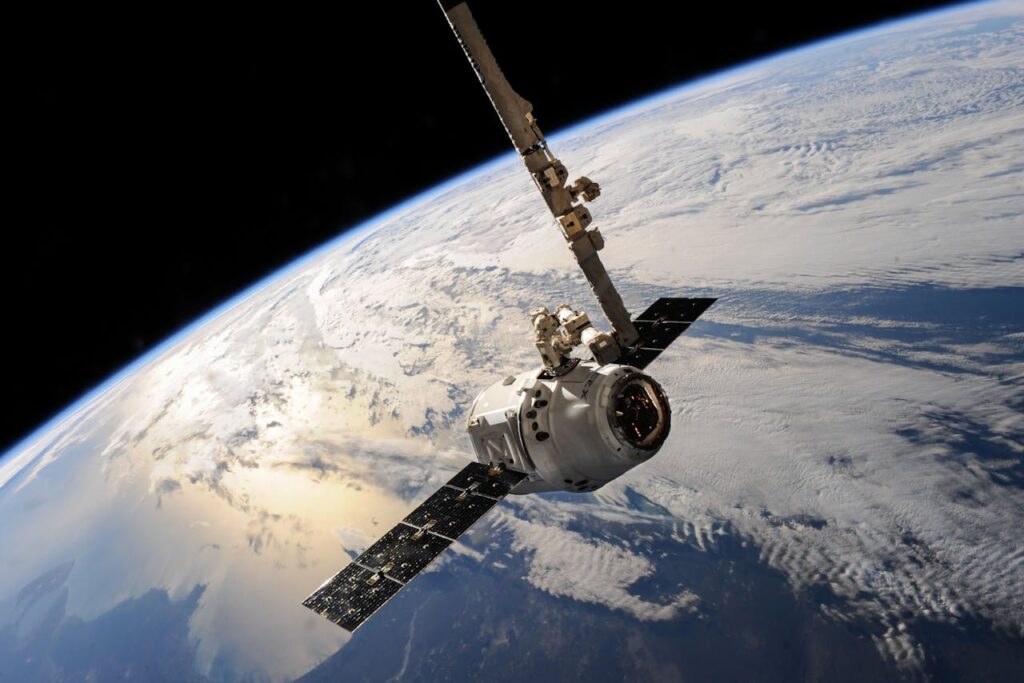
Foto: SpaceX auf Pexels